The History of Ocean Park

Before the Founding of Ocean Park

Ocean Park sits on the ancestral land of the Abenaki people, members of the Wabanaki Confederacy, which by the 1680s had the Saco River as its treaty-recognized southern border. The area was visited by Europeans as early as 1605 when Samuel de Champlain explored and mapped Saco Bay and the Saco River before continuing on to Cape Cod and eventually to found the city of Quebec.

In 1636, Thomas Rogers arrived from Salem MA and planted an apple orchard on the hill where Union Ave now runs. Conflict with the indigenous community caused Rogers to abandon his farm in 1675, but the orchard remained a visible landmark from the sea, and gave rise to the name of Old Orchard Beach. Googins Rocks, the outcropping of rock visible at low tide between Ocean Park and the pier, was named for Patrick Googins, who arrived in 1722 to become the first permanent white settler in the area.

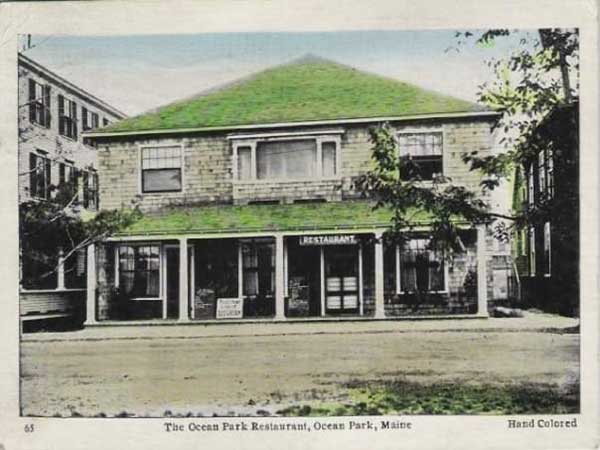
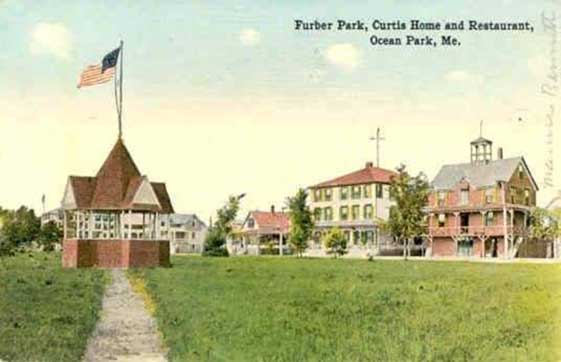
Ocean Park Association — Vintage / Furber Park
Ocean Park Association — Vintage History

Ocean Park is Founded

The idea of Ocean Park was first discussed at the centennial conference of the Free Will Baptist denomination at The Weirs, NH in July 1880. (The Free Will Baptists later changed their name to the Free Baptists before joining with the Northern Baptists in 1911, which later became the American Baptist Churches USA.) At that time, many denominations were organizing summer encampments along the lines of the Methodist camp at Chautauqua, NY. Among those advocating for an encampment were several leaders from Bates College, a Free Will Baptist institution in Lewiston, ME, thus cementing a long-standing relationship between the College and Ocean Park.

The conference at The Weirs appointed a committee to find a suitable seaside location; they considered eight possibilities along the New England coast before recommending the purchase of the 45-acre Guilford property in Old Orchard Beach for $5,000. In the fall of 1880, the denominational leaders gathered to walk the beach and woods, and to dedicate the land with prayer.

On January 24, 1881, the State of Maine approved a charter for the Ocean Park Association (OPA) as a corporation “to establish a place of summer resort for holding religious, educational, and other meetings at Old Orchard Beach, in Saco, in the County of York.”

One appeal of the Ocean Park site was the existence of the “Dummy” railroad, which first opened in 1880 and served the summertime communities of Saco Bay until 1923. This line ran from the Boston & Maine railroad station in Old Orchard Beach southwestward, stopping anywhere upon request on its way to Camp Ellis, at the mouth of the Saco River, where passengers could connect with steamers to various points. This service made it quite convenient to travel to Ocean Park from anywhere else in the country via either rail or ship.

One of the first and most important projects of the new Association was the construction of a space for worship and other community functions. The Temple  (officially named the “Way of Truth Temple”), an octagonal building seating a thousand people, was built under contract by James Bickford of Portland in six weeks at a cost of $3,550 plus an additional $42 for making and painting the shutters, and was dedicated on August 2, 1881. “Legend has it that carpenters labored on the roof by moonlight for a week prior to the dedication in order to be finished by the specified date.” (The Story of Ocean Park, p. 26)

As Adelbert Jakeman described it, “the first year in the history of Ocean Park was crowded with activity, meetings, and dreams. Land was cleared, marshy spots were filled, street work was petitioned from Saco, building was begun, committees were named, and the community itself became a human beehive. The original charter was amended, as were the By-laws, with more of the latter being added as requirements for them increased.” (The Story of Ocean Park, p. 24)

The original town plan provided for 300 cottage plots, all of a uniform 50 by 60 feet. Thirty cottages were built in that first year. By 1895, there were more than 100 cottages in Ocean Park.
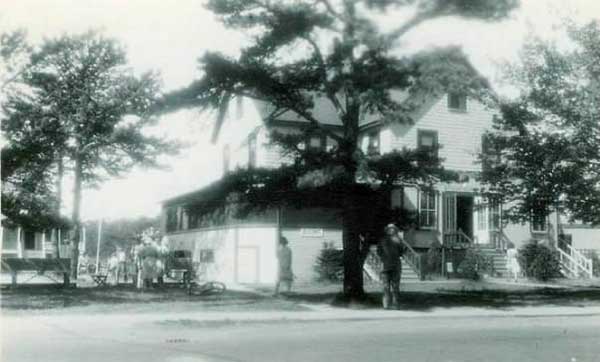
Ocean Park Association — Vintage / Ocean Park Restaurant
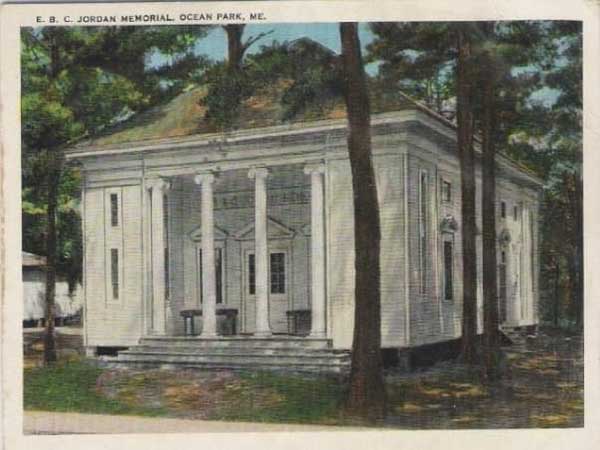
Ocean Park Association — Vintage / Jordan Hall

Ocean Park Expands

As the programs of both the Association and its various Allied Organizations expanded, more facilities were needed. Porter Memorial Hall was dedicated in 1902 and Jordan Hall in 1915. The Acquaintance Club spearheaded the construction of the Memorial Library in 1924. The shuffleboard courts were built, and the game thus introduced to Ocean Park, by the Florida Club in 1930. The Agnes L. Park Recreation Building was built by the Educational Bureau in 1949.

In 1926-27, the Temple was altered and expanded to suit the needs of the day. The center column was cut short (previously it had reached the floor) in order for films to be shown, and the platform was built out in the back, so that three hundred more seats could be accommodated in the congregation. With the addition in 1953 of benches in the grove between the Temple and Porter Hall, the overall seating capacity reached its maximum of 1,450 persons.

From the beginning, Ocean Park hosted numerous well-attended conferences on religious and educational topics of interest, and an intentionally-ecumenical spirit was encouraged. Speakers at Sunday worship were consistently among the most highly-acclaimed preachers in the country, from a variety of races and denominational backgrounds. The musical program attracted many professional musicians. The New England Baptist Conference and the Royal Ambassador Boys’ Camp both acquired land on the southwestern side of Ocean Park, and operated programs equipping children, teens and young adults for religious service.

Early challenges faced by the Association included control of floodwaters, relations with the town of Old Orchard Beach, financial constraints, and supply of potable drinking water. For a long time, drinking water supply was the Association’s primary source of income, leaving it perpetually financially stressed. Finally, in 1951, membership dues were instituted in order to put the organization on more solid footing.

The original land purchased in 1880 is but a sliver of the current Ocean Park boundaries. Additional land was gradually added, including the 1927 reclamation of Ocean Foreside from the meanderings of the Goosefare Brook. By 1930, Ocean Park extended from the south side of Tunis Avenue to the Goosefare Brook, and from the beach to the railroad tracks. There are currently about 500 house lots in Ocean Park.

To continue exploring Ocean Park’s rich history, visit the Historical Society room in Porter Hall. The exhibits are open to the public after worship every Sunday. Learn more about all the historical buildings in the Temple Square.

Several historical accounts of Ocean Park’s history have been published over the decades, and are available in the Memorial Library. The 1956 history by Adelbert M. Jakeman entitled “The Story of Ocean Park” is available online for viewing here:

Story of Ocean Park Archive

Story of Ocean Park PDF

Sources:
The Story of Ocean Park by Adelbert M. Jakeman, published by the Ocean Park Association, Ocean Park, Maine, 1956.

Centennial History of Ocean Park, ME 1881-1981 by Adelbert M. Jakeman, published by the Ocean Park Association, Ocean Park, Maine, 1956.

Ocean Park Association Presidents 1881 – Present

Oren B. Cheney1881 – 1885
Rufus L. Deering1885 – 1893
Lindley M. Webb1893 – 1925
George H. Hamlen1925 – 1928
Edwin H. Milliken1928 – 1944
Percy C. Hicks1944 – 1948
Edward R. Schwartz1948 – 1952
Percy C. Hicks1952 – 1956
Robert B. Harvey1956 – 1960
Hartley T. Grandin1960 – 1964
Rufus H. Bond1964 – 1968
Norman M. Winch1968 – 1972
John F. Kennett1972 – 1974
Alice P. Bentley1974 – 1976
Victor F. Scalise, Jr.1976 – 1978
Donald P. Dickinson1978 – 1980
George H. Sinclair, Jr.1980 – 1985
Albert D. Boulanger1985 – 1986
William S. Holt, M.D.1986 – 1991
Edith F. Read1991 – 1993
Jack J. Jackson1993 – 1996
Frank J. Gwalthney, Jr.1996 – 2000
Audrey Young DeLoffi2000 – 2003
Brian F. Olsen2003 – 2006
Susan I. Evans2006 – 2009
Winthrop A. Winch2009 – 2012
William Holt, M.D.2012 – 2015
Deborah Guimont2015 – 2018
David Keene2018 – 2021
Robert Drake2021 – 2023
Cindy Benedict2023 – 2025
Linda Lauritano2025 – Present

© Copyright 2025 Ocean Park Association. A 501(c)(3) organization. All Rights Reserved.